Request a Quote
Bar TFT Display Technology

Bar TFT Display Technology

Bar type TFT LCD modules from 2.86" to 12.3" with ultra-wide aspect ratios and resolutions up to 1920x720. Find out how bar displays work, how to choose an interface and where an elongated display makes the difference in product design.

Winstar Bar Type TFT Display Modules

Overview

A bar TFT display, also called a bar LCD or stretched display, is a full colour active matrix LCD with a long, narrow active area. Where a standard TFT has a 4:3 or 16:9 aspect ratio, bar displays run from around 2.5:1 to more than 5:1, so a single module can show status, controls and graphics along a slim strip of panel space where a conventional screen would be too tall to fit.

As the authorised distributor for Winstar Display Corporation we offer bar type TFT LCD modules from 2.86" to 12.3" with resolutions up to 1920x720. Most models use IPS panels for wide viewing angles, with SPI+RGB, RGB, MIPI DSI, LVDS or HDMI interfaces, high brightness options up to 1000 cd/m² and optional projected capacitive touch (PCAP) with optical bonding.
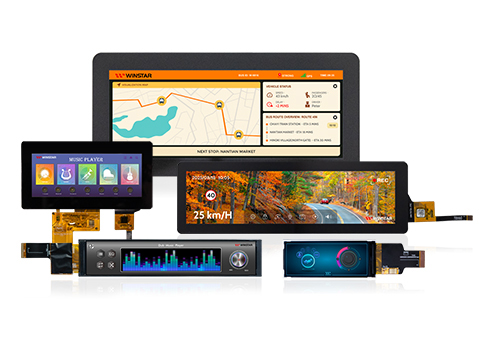
Sizes from 2.86" to 12.3"

Resolutions from 480x128 to 1920x720

IPS wide viewing angle on most models

SPI+RGB, RGB, MIPI DSI, LVDS and HDMI interfaces

High brightness options up to 1000 cd/m²

Optional PCAP touch with optical bonding

How a Bar TFT Works

Electrically, a bar TFT works like any other TFT LCD. A driver IC scans the rows and columns of the panel and your graphics are written into a frame buffer. What changes is the shape: an 8.8" bar display has the same diagonal as a small tablet, but at 480x1920 it is four times as long as it is tall.

Many bar panels are scanned along their long edge, which is why resolutions are often written as 480x1920 or 280x1424 rather than the other way round. To the driver the display is a tall, narrow portrait screen; mounted in landscape, your software simply rotates the graphics by 90°. The datasheet for each model confirms its native orientation.

A standard 16:9 TFT compared with a 4:1 bar TFT, and a portrait-scanned bar panel rotated for landscape use Standard TFT 16:9, e.g. 800x480 Bar TFT 4:1, e.g. 1920x480 viewed in landscape 72 km/h ◀ Track 04 ▶ 21.5° Native scan: 480 x 1920 Mounted in landscape: rotate graphics 90° Driver scans 1920 lines along the long edge Wide landscape interface

Simplified illustration: a bar display packs a wide interface into a slim strip, and portrait-scanned panels are rotated in software

Advantages of Bar TFT Displays

Why designers choose a bar display for products where a conventional screen would be too tall

Fits Narrow Spaces

A long, slim active area fits rack panels, 1U server fronts, dashboards and shelf edges where a 16:9 display simply would not fit.

More Information in One Strip

Show status, controls, media and messages side by side on a single module, replacing several small displays or indicator panels.

IPS Viewing Angles

Most models use IPS panels, with 80° viewing angles in every direction on many, so a long display reads evenly from end to end and from the side.

High Brightness Options

Versions from 800 to 1000 cd/m² keep graphics readable in bright retail, vehicle and outdoor-facing installations.

Touch Ready

Optional PCAP touch, with optical bonding on selected models for improved contrast and durability.

Easy Integration

From SPI+RGB and RGB for microcontrollers, through MIPI DSI and LVDS for application processors, to an 8.8" HDMI model with its own control board.

Choosing an Interface

The right interface depends on resolution, cable length and the processor in your design. Smaller bar displays use SPI+RGB or a parallel RGB bus, well supported by microcontrollers with an LCD controller. Higher resolution models use MIPI DSI or LVDS to connect to an application processor, with LVDS also suited to longer cable runs. For the quickest route to a working display, the HDMI model plugs straight into a PC or single board computer.

Our engineers can help match a display and interface to your host system and arrange samples.

Ask Our Engineers
Interface Typical Displays Best Suited To
SPI + RGB2.86" 376x960MCUs with an LCD controller, compact designs
24-bit RGB4.6" 800x320 (ST7262)MCUs and MPUs with a parallel RGB bus
MIPI DSI7.0" 280x1424 (4-lane)Application processors, high resolution
LVDS6.75", 12.3" 1920x720Larger displays, longer cable runs
HDMI (DVI)8.8" 480x1920 with control boardPCs and single board computers

Bar TFT Range

Compare our bar display modules by size, resolution, interface and touch option

Model Size Resolution Interface Features
WFN0286A2S0WADNA0002.86"376x960SPI+RGBIPS, high brightness, PCAP
WF39BTLASDNN03.9"480x128Contact us for full specification
WFN0460B2S0YADNC0004.6"800x32024-bit RGBIPS, 850 cd/m²
WF52ATZASDNG05.2"480x128Contact usO-Film, 5-point PCAP
WFN0520A2T0YADNN0005.2"480x128Contact usIPS, 500 cd/m², 85° viewing angles
WFN0520A2S0YADNC0005.2"480x128Contact usIPS, PCAP
WF0675ATYAB6LNN06.75"Contact usLVDSNV3051F-L driver IC
WF70C9SYAB4MNN07.0"280x1424Contact usIPS, 1000 cd/m²
WF70C9SYAB4MNC1B7.0"280x14244-lane MIPI DSIIPS, PCAP, optical bonding, fits 1U chassis
WF88BTYA8MNG108.8"480x1920Contact usPCAP
WF88BTYF8MHG1V8.8"480x1920HDMI (DVI)Integrated control board
WL0F00088000BGXAANA008.8"STM32N657 Edge AI development boardIPS touch display, camera interfaces
WFN1025A2S0WALNA00010.25"1920x720Contact usIPS, PCAP, optical bonding
WF123ETWAYLNN012.3"1920x7208-bit D-LVDSIPS, 800 cd/m², ultra-wide temperature
WF123BSWAYLNB012.3"1920x7202-channel LVDSIPS, high brightness, PCAP

Full specifications are available on each product's datasheet. View Bar TFT Displays →

2.86~12.3"
Display Sizes
1920x720
Max Resolution
1000
cd/m² Max Brightness
5
Interface Options

Typical Applications

Bar TFT modules suit any device that calls for a long, slim display area

Servers & Rack Equipment

Status and control displays on 1U and 2U server fronts, network and test equipment.

Automotive, Marine & Aviation

Dashboards, instrument clusters and control panels where space is long but shallow.

Passenger Information

Train carriage and onboard displays for route, stop and service information.

Retail & Digital Signage

Shelf-edge, point of purchase and advertising displays in bright retail spaces.

Industrial HMI & Audio

Control panels, instrumentation, pro audio and mixing equipment with strip-style interfaces.

Medical & Security

Medical monitoring systems, intercoms and security equipment needing a compact, readable display.

Frequently Asked Questions

Many bar panels are scanned along their long edge, so the driver sees them as a tall, narrow portrait display. When the module is mounted in landscape, your software rotates the graphics by 90°. Most modern graphics libraries and Linux display drivers handle this rotation, and the datasheet confirms the native orientation for each model.

For smaller bar displays driven by a microcontroller, SPI+RGB or 24-bit RGB are common. Higher resolution models use MIPI DSI or LVDS for connection to an application processor, with LVDS also suiting longer cable runs. If you want to connect directly to a PC or single board computer, the 8.8" HDMI model has an integrated control board. Our engineers can advise on the best match for your host system.

Yes. Models from 2.86" to 12.3" are available with projected capacitive touch (PCAP), several with optical bonding for improved readability and durability.

Most models in our bar range use IPS panels, giving wide viewing angles and consistent colour, which matters for long displays viewed from the side. See IPS TFT Technology →

Yes. We can help with custom cover glass and bezels, touch panels, backlight brightness, FPC and cable assemblies to suit your enclosure and electronics. See TFT LCD Module Customisation →

Related Products

Need a Custom Solution?

Our engineering team can help specify or develop a custom solution for your exact requirements.

Talk to Our Engineers