How In-Plane Switching works, and why it gives sharper, more consistent images from every viewing angle than conventional TN TFT displays.
Overview
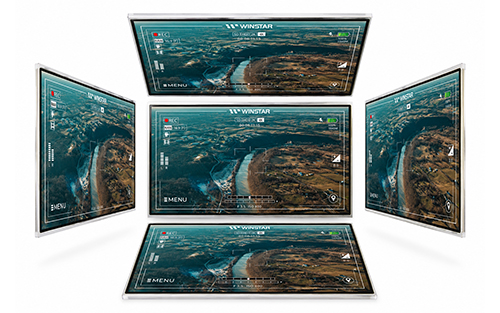
IPS (In-Plane Switching) is a type of TFT LCD panel in which the liquid crystal molecules rotate parallel to the glass rather than tilting up out of it. Because the crystals stay in the same plane, light passing through the panel is controlled the same way whether you look at the screen straight on, from the side, from above or from below.
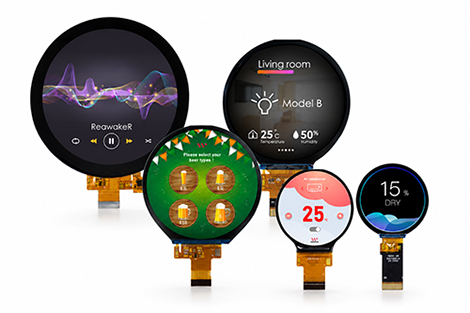
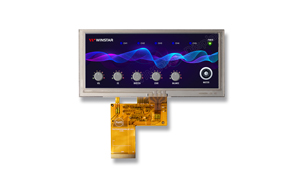
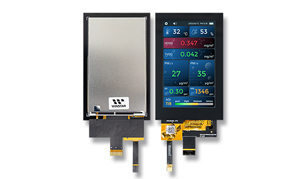
The result is a display with a super-wide viewing angle, accurate and stable colour, deep blacks and high contrast. Winstar's IPS TFT modules, supplied in the UK by Plus Opto, range from a mini 0.96" display up to 15.6", including round, bar and portrait formats, high-brightness and sunlight-readable versions, and optional resistive (RTP) or projected capacitive (PCAP) touch.
The technology
In a conventional TN (Twisted Nematic) panel the electrodes sit on the top and bottom glass. When voltage is applied the liquid crystals tilt up towards the viewer, so the amount of light reaching your eye changes depending on where you are looking from. Off-axis the image fades, shifts colour or even inverts.
In an IPS panel both electrodes sit side by side on the same glass substrate. The electric field runs across the cell, so the crystals rotate horizontally within the plane of the screen. The optical path is almost identical from any angle, which is why brightness, contrast and colour stay so consistent.
Benefits
Why designers choose IPS for products where the screen has to look right to every user, in every position.
Typically 80–85° up, down, left and right. Panels can be mounted in any orientation and read clearly by operators standing to the side, above or below.
Minimal colour shift off-axis and up to 16.7M colours. Quantum-dot IPS options extend the colour gamut further for richer, more natural images.
TN panels can show a reversed, "negative" image from their weak viewing direction. IPS has no inversion zone, so there is no preferred "6 o'clock" or "12 o'clock" mounting.
IPS panels are normally black: with no signal they block the backlight. That gives true blacks and contrast ratios from 800:1 up to 1500:1 on our range.
Because the crystals are held in-plane, IPS panels show little of the ripple or "pooling" that pressing on a TN panel can cause. Available with RTP or multi-touch PCAP.
High-brightness versions from 750 to 1100 cd/m² and sunlight-readable models, plus wide-temperature parts for operation up to +85 °C.
| Characteristic | TN TFT | IPS TFT |
|---|---|---|
| Viewing angle | Narrow, uneven by direction | Wide, 80–85° in all directions |
| Colour shift off-axis | Noticeable | Minimal |
| Greyscale inversion | Yes, in one direction | None |
| Display mode | Normally white | Normally black |
| Contrast ratio | Typically 300–600:1 | Typically 800–1500:1 |
| Touch pressure response | Visible ripple | Very stable |
| Mounting orientation | Restricted by best view direction | Any orientation |
| Relative cost | Lowest | Slightly higher |
IPS vs TN
TN TFTs remain a cost-effective choice where the viewer is always directly in front of the screen. If your product will be viewed from different positions, mounted at an angle, rotated to portrait, or needs to reproduce colour accurately, IPS is usually the better choice for a small increase in cost.
Not sure which suits your design? Our engineers can compare options side by side and arrange samples.
IPS TFT modules are used wherever image quality and readability from any angle matter.
Control panels and machine interfaces read by operators from many positions, often in harsh temperatures.
Patient monitors and diagnostic equipment where accurate colour and clarity are critical.
Dashboards and charge point screens that must stay readable in bright light. Read more →
Wall controllers, thermostats and access panels, including round IPS displays for decorative designs.
Mixing desks and rack equipment viewed from above and at an angle. Read more →
Fitness trackers, gauges and handheld meters using compact and circular IPS displays.
Our range
Browse our IPS modules or talk to us about customising a display, backlight or cable for your design.
FAQ
Our engineering team can help specify the right size, brightness, interface and touch option, or develop a custom solution for your exact requirements.
Talk to Our Engineers