OLED Touchscreen Technology
Graphic OLED displays from 0.91" to 5.5" with capacitive touch built in. Find out how the touch panel is added to an OLED, the difference between add-on and in-cell touch, and how to choose a structure and interface.
Graphic OLED displays from 0.91" to 5.5" with capacitive touch built in. Find out how the touch panel is added to an OLED, the difference between add-on and in-cell touch, and how to choose a structure and interface.
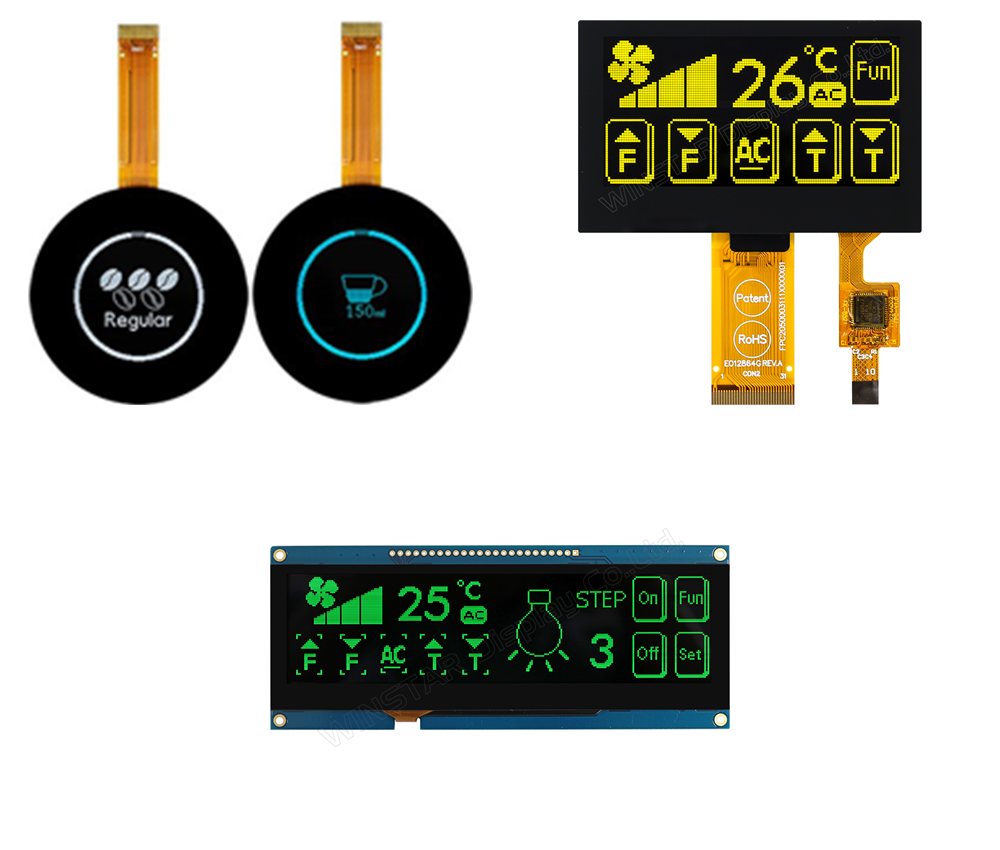
An OLED touchscreen display combines a self-emitting graphic OLED with a capacitive touch panel (CTP) in a single module. The OLED gives deep blacks, high contrast and wide viewing angles with no backlight, and the touch panel senses a finger through the cover glass, so the display can also be the control panel. That suits compact products such as smart home controls, appliances, wearables and medical devices.
As the authorised distributor for Winstar Display Corporation we offer OLED touch modules from the 0.91" 128x32 with in-cell touch up to the 5.5" 256x64, including a 1.18" round display. Modules come as bare COG or COF glass, or mounted on a frame and PCB, in white, yellow, sky blue or green.
Capacitive touch on one module
Sizes from 0.91" to 5.5"
Add-on or in-cell touch
SPI, I2C and parallel interfaces
No backlight needed
Round and bar formats
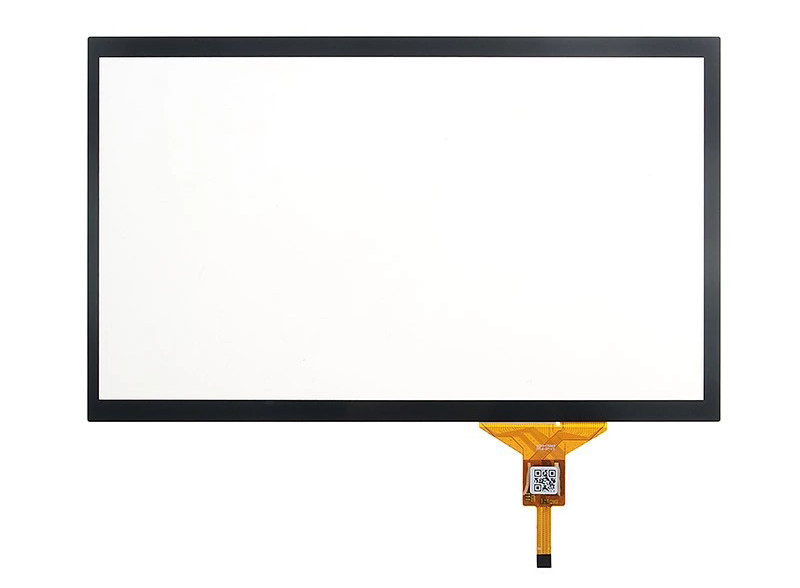
A capacitive touch panel carries a grid of transparent electrodes. Your finger changes the electric field between them, and the touch controller works out where it is. Because the panel senses through glass, it needs no pressure and has no moving parts.
On most of the range the touch panel is a separate layer on top of the OLED, with its own touch controller, joined to the display by air bonding or optical bonding. The 0.91" uses in-cell touch instead: the sensing is built into the OLED panel and a single TDDI chip drives the display and reads the touch.
Simplified illustration, not to scale: layer thicknesses are exaggerated for clarity
Why designers choose an OLED with touch for compact control panels
Unlit pixels are truly black, so icons and text stand out clearly, even through a touch panel.
Self-emitting pixels look the same from almost any angle, ideal for wall and appliance controls.
Touch keys on the display replace mechanical buttons, for a sealed, easy-clean front.
No backlight layer, and the in-cell 0.91" is just 1.41mm thick, suiting wearables and slim devices.
The SSD7317 TDDI on the 0.91" drives display and touch from one chip, saving parts and space.
Frame and PCB versions add mounting holes and a pin header, making them simple to fit.
COG (chip on glass) and COF (chip on film) modules are the thinnest, with the driver on the glass or on the flexible cable, ready to fit behind your own front panel.
Frame and PCB versions mount the display on a board with a metal frame, screw holes and a pin header, for easy fitting and hand assembly.
| Structure | Models | Thickness |
|---|---|---|
| COG | 0.91", 1.18", 1.54", 2.42" WEO012864G, 2.7" WEO012864Q, 3.55" | 1.41 to 5.0mm |
| COF | 3.12" WEX025664B | 3.17mm |
| Frame + PCB | 2.42" WEO012864J, 2.7" WEP012864Q, 2.8", 3.12" WEN025664B, 5.5" | 4.8 to 10.2mm |
The display and the touch panel connect separately on most models. The display interface depends on the driver IC, from I2C for the fewest wires to a parallel bus for the fastest updates. The touch controller usually reports over I2C.
Our engineers can help match a display and interface to your design and arrange samples.
| Driver IC | Display interfaces | Used On |
|---|---|---|
| SSD7317 (TDDI) | SPI, I2C | 0.91" 128x32 |
| SSD1327 | SPI, I2C | 1.18" 128x128 round |
| SSD1309 | 6800, 8080, SPI, I2C | 1.54", 2.42", 2.7" 128x64 |
| SSD1322 | 6800, 8080, SPI | 2.8", 3.12", 3.55", 5.5" 256x64 |
Compare our OLED touch modules by size, resolution, driver IC, interface, structure and outline
| Model | Size | Resolution | Driver IC | Interface | Structure | Outline (mm) |
|---|---|---|---|---|---|---|
| WEO012832M-CTP | 0.91" | 128x32 | SSD7317 | SPI, I2C | COG, in-cell touch | 30.0 x 11.5 x 1.41 |
| WEO128128D-CTP | 1.18" | 128x128 round | SSD1327 | SPI, I2C | COG | Ø50.5 x 5.0 |
| WEO012864A-CTP | 1.54" | 128x64 | SSD1309 | 6800, 8080, SPI, I2C | COG, air or optical bonding | 43.04 x 28.22 x 3.01 |
| WEO012864G-CTP | 2.42" | 128x64 | SSD1309 | 6800, 8080, SPI, I2C | COG | 66.8 x 41.3 x 3.71 |
| WEO012864J-CTP | 2.42" | 128x64 | SSD1309 | 6800 (8080 option), SPI, I2C | COG + frame + PCB | 75.0 x 52.7 x 10.2 |
| WEO012864Q-CTP | 2.7" | 128x64 | SSD1309 | 6800, 8080, SPI, I2C | COG | 74.8 x 44.16 x 3.66 |
| WEP012864Q-CTP | 2.7" | 128x64 | SSD1309 | 6800, 8080, SPI, I2C | COG + frame + PCB | 82.0 x 47.5 x 8.65 |
| WEN025664A-CTP | 2.8" | 256x64 | SSD1322 | 6800, 8080, SPI | COF + frame + PCB | 85.0 x 39.8 x 7.83 |
| WEX025664B-CTP | 3.12" | 256x64 | SSD1322 | 6800, 8080, SPI | COF | 89.2 x 29.0 x 3.17 |
| WEN025664B-CTP | 3.12" | 256x64 | SSD1322 | 6800, 8080, SPI | COF + frame + PCB | 89.2 x 44.0 x 7.98 |
| WEO025664D-CTP | 3.55" | 256x64 | SSD1322 | 6800, 8080, SPI | COG | 100.4 x 36.1 x 3.34 |
| WEN025664D-CTP | 5.5" | 256x64 | SSD1322 | 6800, 8080, SPI | COF + frame + PCB | 147.0 x 59.0 x 4.8 |
Figures from Winstar's specifications. See the datasheet or contact us for details. View OLED Touchscreen Displays →
OLED touchscreens suit compact products where the display is also the control panel
Thermostats, lighting controls and wall panels.
Coffee machines, cookers and kitchen appliances with touch keys.
Bands and personal devices using the thin in-cell 0.91".
Smart healthcare and portable medical instruments.
Compact operator panels and instrument front panels.
Chargers, meters and energy monitoring displays.
Our engineering team can help specify or develop a custom solution for your exact requirements.
Talk to Our Engineers