Self-emissive passive matrix OLED modules from 0.49" with resolutions from 50x16 to 256x64, in COB, COG, COG+PCB and COF construction. Find out how graphic OLEDs work, how to choose a structure and interface, and where they outperform LCDs.
A graphic OLED (Organic Light Emitting Diode) display is a dot matrix display in which every pixel produces its own light. There is no backlight, so pixels that are off are completely black. The result is a display with very high contrast, wide viewing angles and fast response, in a module that is thinner, lighter and uses less power than an equivalent LCD when showing typical text and graphics.
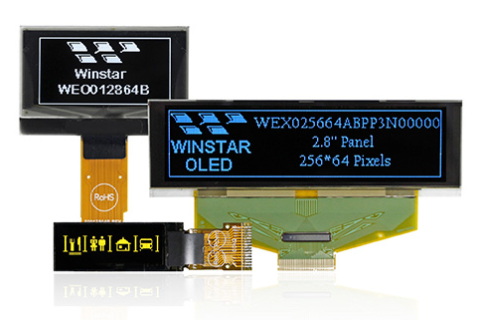
As the authorised distributor for Winstar Display Corporation we offer monochrome graphic OLED modules from the 0.49" 64x32 micro OLED upwards, with resolutions including 50x16, 64x32, 96x64, 128x32, 128x64, 128x128, 206x36 and 256x64. Each module has an on-board controller supporting I²C, SPI or 6800/8080 parallel interfaces, in COB, COG, COG+PCB and COF mechanical structures.
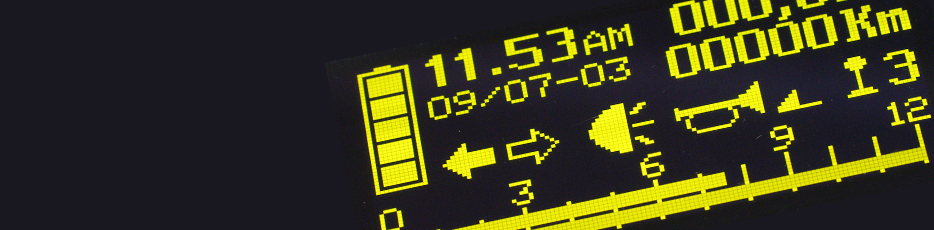
Self-emissive: no backlight required
Contrast ratio up to 10,000:1
Resolutions from 50x16 to 256x64
I²C, SPI and 6800/8080 parallel interfaces
COB, COG, COG+PCB and COF structures
Operation down to -40℃ on selected models
An LCD is a light valve: a backlight shines continuously and the liquid crystal layer blocks or passes that light at each pixel. Even a black pixel lets a little light through. An OLED works the other way round. Thin organic layers sit between two sets of electrodes, and each pixel glows only when current flows through it. Black pixels are simply switched off.
Graphic OLED modules use a passive matrix. Rows of anodes and columns of cathodes cross at every pixel, and the controller scans the rows one at a time, very quickly, while the columns carry the pixel data. The scan rate is shown as the duty cycle: a 128x64 display runs at 1/64 duty, a 128x32 at 1/32. The controller, such as the SSD1306 or SH1106, stores the image in its own memory and handles the scanning, so your microcontroller only writes data when the picture changes.
Simplified illustration: the highlighted row is being scanned, and pixels light where it meets an active column
Why designers choose OLED over a backlit LCD for small displays
Unlit pixels emit no light at all, giving contrast ratios of up to 10,000:1 and crisp, clear text and graphics.
Light comes from the pixel itself, so the image stays bright and readable from almost any direction.
OLED pixels switch in microseconds, with no liquid crystal to rotate, so scrolling and animation stay sharp even in the cold.
Only lit pixels draw current. A 0.95" 96x64 display typically draws just 6mA, ideal for battery powered devices.
No backlight unit means COG modules as slim as 1.26mm, for wearables and handheld instruments where every gram counts.
Selected models operate from -40℃ to +80℃, without the slow response that LCDs suffer at low temperatures.
Graphic OLEDs come in several mechanical structures. The choice depends on how much space you have, how the display will be mounted, and whether you are replacing an existing LCD.
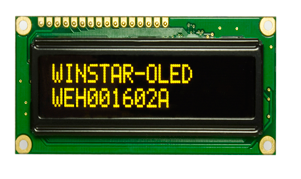
COB modules are a direct alternative to many STN LCDs: the 50x16 WEH005016A shares the outline and pin out of the WH0802A, and the 76x16 WEG007616A matches the WH1202A, needing only a small PCB change.
| Structure | Construction | Best Suited To |
|---|---|---|
| COB | Chip on Board: controller on a PCB with mounting holes | Easy mounting, replacing STN character LCDs |
| COG | Chip on Glass: controller on the glass, ZIF FPC or Hotbar | Thinnest, lightest designs, wearables |
| COG + PCB | COG panel on a PCB with header pins | Rapid prototyping, simple hardware |
| COF | Chip on Film: controller on the flex circuit | Larger, higher resolution panels |
Most OLED controllers support several interfaces, selected by pin settings on the module. I²C needs only two wires, SPI is faster for animation, and 8-bit parallel gives the highest throughput where your microcontroller has the pins to spare.
Our engineers can help match a display, controller and interface to your design and arrange samples.
| Interface | Wires | Best Suited To |
|---|---|---|
| I²C | 2 (clock, data) | Small displays, low pin count MCUs |
| SPI (3 or 4-wire) | 3 to 4 | Faster updates, animation |
| 6800 / 8080 parallel | 8 data + control | Highest throughput, larger displays |
Compare our graphic OLED modules by size, resolution, structure, controller and interface
| Model | Size | Resolution | Structure | Controller | Interface |
|---|---|---|---|---|---|
| WEO006432A | 0.49" | 64x32 | – | SSD1306 | I²C |
| WEO006448B | 0.66" | 64x48 | – | SSD1315 | Multiple |
| WEO009632C | 0.68" | 96x32 | COG | SSD1315 | 6800/8080, I²C, SPI |
| WEO004864A | 0.71" | 48x64 (portrait) | COG | SSD1306 | I²C |
| WEO012832F | 0.91" | 128x32 | – | – | I²C |
| WEA012832D | 0.91" | 128x32 | COG+PCB | – | – |
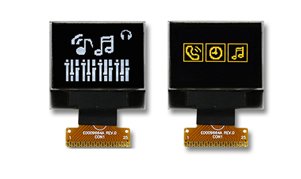
| WEO009664D | 0.95" | 96x64 | COG | SSD1315 | 6800/8080, I²C, SPI |
| WEO012864AC | 0.96" | 128x64 | – | SSD1315 | I²C, SPI, 6800, 8080 |
| WEO012864MX | 0.96" | 128x64 dual colour | COG | – | – |
| WEA012864D-01 | 0.96" | 128x64 | On PCB | – | – |
| WEO128128D-CTP | 1.18" round | 128x128 | – | SSD1327 | SPI, I²C, with touch |
| WEH005016A | 1.26" | 50x16 | COB | – | – |
| WEO012864L | 1.28" | 128x64 | COG | SH1106 | 6800/8080, SPI, I²C |
| WEG007616A | 1.7" | 76x16 | COB | WS0010 | 6800, 8080, SPI |
| WEG010016A | 2.4" | 100x16 | COB | – | 6800, 8080, SPI |
| WEO012864G | 2.42" | 128x64 | – | SSD1309 | 6800, 8080, SPI, I²C |
| WEO020636A | 2.55" | 206x36 | COG | – | – |
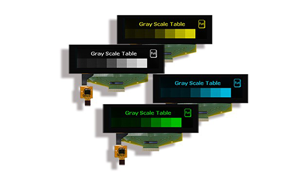
| WEX025664B | 3.12" | 256x64, 4-bit greyscale | COF | SSD1322 | 6800/8080, SPI |
– see datasheet or contact us for details. View Graphic OLED Displays →
Graphic OLED modules suit compact devices that need a bright, sharp, low power display
Fitness bands, smart accessories and MP3 devices needing a tiny, lightweight display.
Meters, testers and portable instruments that must read clearly indoors and out.
Health monitors, medical devices and personal care products with compact user interfaces.
Thermostats, smart controls and appliance status displays.
Connected sensors, smart meters and gateways where low power matters.
Control panels and equipment operating in cold or demanding environments.
Our engineering team can help specify or develop a custom solution for your exact requirements.
Talk to Our Engineers