How compact constant voltage LED drivers power LED strip and modules indoors, and how to choose the right voltage, power and installation for even, reliable light.
Overview
A compact constant voltage (CV) LED driver converts mains AC into a fixed, regulated low-voltage DC supply, typically 12V, 24V or 48V, in a small plastic case for indoor use. The driver holds the voltage steady and the connected LED strip or modules draw the current they need, up to the driver's maximum rating.
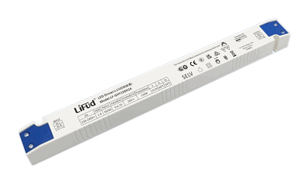
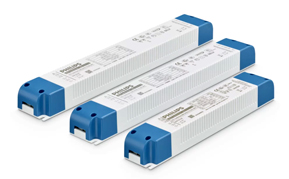
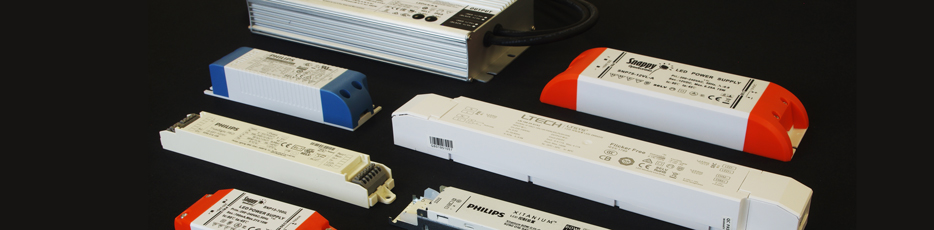
CV drivers power LED products that have their own built-in current control, such as flexible and rigid LED strip, neon flex and chain modules. Our compact range from Snappy, Philips and Lifud covers power ratings from 8W to 320W, with IP20 cases for dry indoor locations and Class II models for independent, remote installation.
The technology
A CV driver holds a fixed output voltage. LED strip and modules connect to it in parallel, and the total load is the sum of every connected run. Keep that total to no more than about 80% of the driver's rating for cool, reliable operation.
Current flowing along cables and the thin copper tracks of LED strip causes voltage drop, so LEDs at the far end of a long run receive less voltage and look dimmer. For the same power, a higher voltage carries less current, so 24V and 48V strips can run further than 12V before brightness falls away.
Feeding long runs from both ends or the middle, and using thicker cable between driver and strip, also keeps brightness even.
Our range
Non-dimmable, fixed output constant voltage drivers for indoor LED installations.
| Series | Power | Output | Input | Enclosure |
|---|---|---|---|---|
| Snappy SEA | 8 – 180W | 12V, 24V, 48V | 200–240VAC | IP20 PC case |
| Snappy SS | 20 – 150W | 12V, 24V, 48V | 200–240VAC | IP20 PC case |
| Snappy SNP | 200 – 320W | 12V, 24V, 48V | 200–240VAC | IP20 PC case |
| Philips 9290-02 | 20 – 150W | 24V | 198–264VAC | IP20, Class II |
| Lifud LF-GHY | 45 – 240W | 24V | 198–264VAC | IP20, Class II |
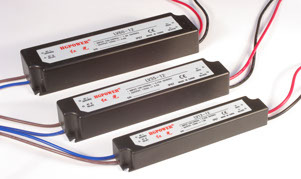
Installing outdoors or in damp locations? See our waterproof CV LED drivers.
| Output | Current for 48W | Voltage drop | Best for |
|---|---|---|---|
| 12VDC | 4A | Highest | Short runs, cabinets, 12V modules |
| 24VDC | 2A | Lower | Most LED strip, coves and linear runs |
| 48VDC | 1A | Lowest | Long runs and large installations |
12V vs 24V vs 48V
The driver voltage must always match the LED product. Connecting 12V strip to a 24V driver will damage it, and 24V strip on a 12V driver will barely light.
When you are choosing both strip and driver, higher voltage halves the current for the same power each time it doubles, reducing voltage drop and allowing longer runs from a single feed.
Benefits
Why compact CV drivers are the standard way to power indoor LED strip and modules.
Small, slim cases fit in ceiling voids, cabinets, plinths and behind furniture.
Connect multiple LED runs in parallel to one fixed-voltage supply, up to the driver's rating.
12V, 24V and 48V outputs with short circuit and over-current protection as standard.
Class II models with cable covers can be installed remotely without a separate enclosure.
From 8W for a single cabinet light up to 320W for large strip installations.
A low-cost, reliable way to power LED strip, neon flex and chain modules indoors.
Installation
4 metres of 24V LED strip at 12W per metre:
Related pages:
Compact CV drivers power LED strip and modules in almost every indoor setting.
Concealed cove and perimeter strip lighting.
Under-cabinet, plinth and wardrobe lighting.
Shelf, showcase and display cabinet lighting.
Lightboxes, channel letters and backlit graphics indoors.
Bars, back-bar shelving and feature lighting.
Powering LED modules in fittings and lighting products.
Explore
Browse the series in our compact constant voltage range.
FAQ
Tell us about your LED strip or modules, voltage and run lengths and our team will recommend the right driver.
Talk to Our Engineers