Request a Quote
Character OLED Display Technology

Character OLED Display Technology

Self-lit character OLED modules from 8x2 to 40x2, sharing the size and pin out of standard STN character LCDs. Find out how character OLEDs work, what the built-in 4 in 1 font controller offers, and how to upgrade an existing LCD or VFD design.

Winstar Character OLED Display Modules

Overview

A character OLED displays text as rows of fixed character cells, just like the familiar 16x2 character LCD. The difference is the display technology: instead of a liquid crystal panel in front of a backlight, every dot is a tiny OLED that produces its own light. Characters appear bright and sharp on a true black background, readable from almost any angle, with no backlight to power.

As the authorised distributor for Winstar Display Corporation we offer character OLED modules in 8x2, 12x2, 16x1, 16x2, 20x2, 20x4 and 40x2 formats, each character made from a 5x8 dot matrix. Standard models share the outline, viewing area and pin out of the equivalent Winstar STN LCDs, making them a simple upgrade for existing products, and they are also a mechanically compatible alternative to vacuum fluorescent displays (VFDs).
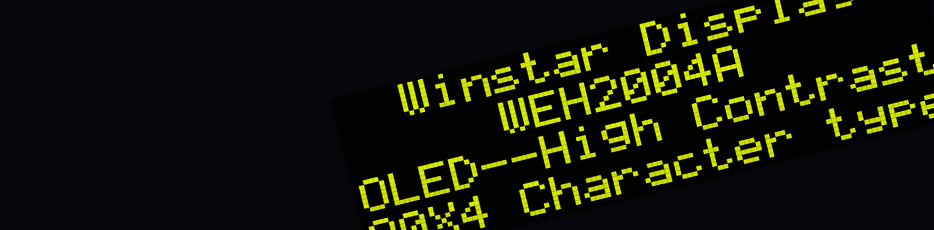
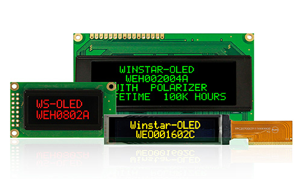
Formats from 8x2 to 40x2 characters

Same size and pin out as STN character LCDs

4 in 1 font ROM: English, Japanese, European, Russian

6800, 8080 and SPI interfaces

Self-lit: no backlight required

Mechanically compatible alternative to VFDs

How a Character OLED Works

The display is divided into character cells, for example 16 cells across and 2 rows down on a 16x2 module. Each cell is a small 5x8 grid of OLED dots, and each dot lights up on its own when current flows through it, so no backlight is needed.

You do not have to draw the characters yourself. Your microcontroller sends a character code and the WS0010 controller looks up the shape in its built-in font ROM, then drives the dots. The ROM holds four font tables, English, Japanese, European and Russian, selected in software, so the same module can display text for several markets. The command set follows the familiar character LCD style, so existing character LCD software usually needs only small changes.

A 16x2 character OLED made of character cells, with one cell enlarged to show its 5x8 dot matrix 16x2 Character OLED 16 characters x 2 lines One Character Cell 5x8 dots, shape stored in font ROM A B C 1 2 3 ä ö ü Д Ж Я P L U S O P T O Your MCU sends a character code, e.g. 0x41 for "A" The controller draws it from the font ROM Bottom row used for the cursor English, Japanese, European and Russian fonts built in

Simplified illustration: each character is a 5x8 dot cell drawn by the controller from its built-in font

Advantages of Character OLED Displays

Why designers upgrade from STN character LCDs and VFDs to character OLEDs

Drop-in Upgrade

Same outline, viewing area and pin out as standard STN character LCDs, so most designs can upgrade without mechanical changes.

Brighter, Higher Contrast

Self-lit characters on a true black background look crisp and clear, with no grey background or backlight bleed.

Wide Viewing Angles

Text stays readable from almost any direction, without the narrow viewing cone of an STN LCD.

Fast Response

OLED dots switch almost instantly, so scrolling text and changing values stay sharp, with no ghosting, even at low temperatures.

Lower Power

No backlight to run, and only lit dots draw current, giving lower consumption than a backlit LCD or a VFD.

Multi-Language Fonts

English, Japanese, European and Russian character sets in one controller, selected in software, for products sold worldwide.

OLED, STN LCD or VFD?

Character OLEDs combine the bright, self-lit look of a VFD with the size, pin out and low voltage operation of an STN character LCD.

If you are maintaining a product that uses a character LCD or a VFD that is becoming hard to source, a character OLED is often the simplest way to refresh the design.

Character OLED STN LCD VFD
Light sourceSelf-litBacklightSelf-lit
ContrastVery high, true blackModerateHigh
Viewing angleWideLimitedWide
SupplyLow voltage logicLow voltage + backlightNeeds high voltage and filament drive
Response at low tempFastSlows in the coldFast

Choosing an Interface

The WS0010 controller supports three interfaces. The default 6800 parallel bus matches most existing character LCD designs and can run in 8-bit or 4-bit mode. 8080 parallel suits processors with an Intel-style bus, while SPI reduces the connection to just a few wires.

Our engineers can help with interface selection, initialisation and samples.

Ask Our Engineers
Interface Data Lines Best Suited To
6800 parallel (default)8 or 4 data + controlReplacing existing character LCDs
8080 parallel8 data + controlProcessors with an Intel-style bus
SPISerial, few wiresNew designs, small MCUs, low pin count

Character OLED Range

Compare our character OLED modules by format, size and the STN LCD they replace

Model Format Diagonal Outline (mm) Duty Replaces STN LCD
WEH000802A8x21.2"58.0 x 32.0–WH0802A
WEH001601B16x12.25"80.0 x 36.01/8–
WEH001602A16x22.29"80.0 x 36.0–WH1602B
WEH002002A20x23.08"–1/16–
WEH002004A20x42.88"–1/16–
WEH004002A40x25.85"––WH4002A

Standard models: COB structure, WS0010 controller with 4 in 1 font ROM, 6800 (default), 8080 and SPI interfaces. 12x2 also available. – see datasheet or contact us. View Character OLED Displays →

8x2~40x2
Character Formats
5x8
Dot Matrix Characters
4 in 1
Built-in Font Sets
3
Interface Options

Typical Applications

Character OLED modules suit any product that shows text, values and simple menus

Industrial Controls

Machine controllers, PLC panels and process equipment showing status and settings.

Test & Measurement

Meters, power supplies and instruments that need clear readings from any angle.

Audio Equipment

Amplifiers, receivers and pro audio gear, including VFD replacement designs.

Medical Devices

Patient equipment and analysers where text must be easy to read in any lighting.

Home & Building Control

Thermostats, alarm panels, access control and appliance displays.

Retail & Point of Sale

Customer displays, vending machines and terminals showing prices and messages.

Frequently Asked Questions

In most cases, yes. Character OLEDs such as the 8x2 WEH000802A, 16x2 WEH001602A and 40x2 WEH004002A share the outline size, viewing area and pin out of the equivalent Winstar STN LCDs (WH0802A, WH1602B and WH4002A). Because the OLED needs no backlight, the backlight supply can be removed, and only small software changes are usually needed.

Yes. Character OLEDs are offered as a mechanically compatible alternative to vacuum fluorescent displays, giving a similar bright, self-lit appearance without the high voltage supply and filament drive that a VFD needs.

The WS0010 controller has a 4 in 1 font ROM with English, Japanese, European and Russian character sets, including ASCII. The font table is selected by software, so one module can serve several markets.

The default 6800 parallel interface, in 8-bit or 4-bit mode, matches most existing character LCD designs. 8080 parallel suits processors with an Intel-style bus, and SPI reduces the connection to a few wires for new designs or small microcontrollers.

As with all OLEDs, brightness slowly reduces over operating life, and characters that are shown continuously at full brightness age faster than the rest of the display. Reducing brightness, turning the display off when idle and avoiding fixed text for long periods all help to extend life. Our engineers can advise on lifetime for your application.

Related Products

Need a Custom Solution?

Our engineering team can help specify or develop a custom solution for your exact requirements.

Talk to Our Engineers