Transflective TFT Technology
Colour transflective TFT LCD modules from 1.75" to 5.0", readable indoors and in direct sunlight. Find out how a transflective display uses ambient light, and how to choose a size, driver IC and interface.
Colour transflective TFT LCD modules from 1.75" to 5.0", readable indoors and in direct sunlight. Find out how a transflective display uses ambient light, and how to choose a size, driver IC and interface.
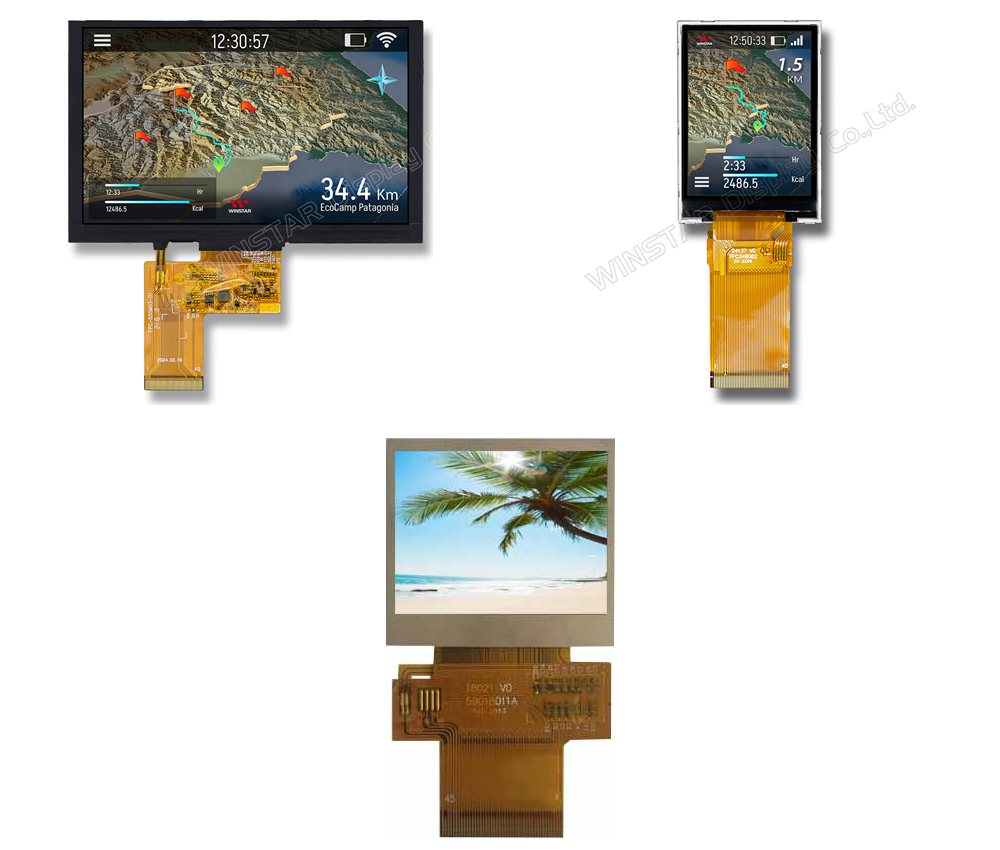
A standard TFT LCD is transmissive: all of its light comes from the backlight, so in bright sunlight the image can wash out. A transflective TFT adds a part-reflective layer behind the liquid crystal. Indoors the backlight lights the image as normal, and outdoors the display also reflects sunlight back through the pixels, so the brighter the light, the clearer the image.
That makes transflective TFTs a good fit for outdoor industrial devices, vehicle GPS displays and handheld equipment, where the display must stay readable in changing light without a power-hungry backlight. We offer full colour transflective TFT modules from the 1.75" 296x222 up to the 5.0" 800x480, including Winstar's 2.4" and 5.0" modules.
Readable in direct sunlight
Sizes from 1.75" to 5.0"
Full colour, up to 800x480
MCU, SPI and RGB interfaces
Lower backlight power outdoors
Operating down to -30℃ and up to +85℃
Like any TFT LCD, each pixel is a liquid crystal light valve with a red, green or blue colour filter, switched by its own thin film transistor. The difference is the layer behind the liquid crystal.
In a transflective panel that layer is part reflector and part window. Light from the backlight passes through the window areas, while ambient light coming in from the front bounces off the reflector areas and back out through the same pixels. Both light paths pass through the colour filter, so the image keeps its colours whichever light is doing the work.
Simplified illustration, not to scale: layer thicknesses and reflector areas are exaggerated for clarity
Why designers choose transflective TFTs for displays used outdoors and on the move
Reflected sunlight lights the image, so the display gets clearer rather than washing out as the light gets brighter.
With ambient light doing more of the work, the backlight can run lower outdoors, saving power in battery equipment.
The backlight still lights the image indoors and at night, so one display works in every lighting condition.
The 5.0" uses an IPS panel, with wide viewing angles in both transmissive and reflective modes.
The 5.0" operates from -30℃ to +85℃, suiting vehicles and outdoor enclosures.
MCU, SPI and RGB interfaces to suit anything from a small microcontroller to an embedded processor.
A transmissive display relies on its backlight, so it is bright indoors but can wash out in sunlight. A reflective display uses only room light, so it reads well in the sun but cannot be seen in the dark.
A transflective display combines the two, giving a readable image in every condition from a dark cab to direct sunlight.
| Display mode | Light source | In the dark | In sunlight |
|---|---|---|---|
| Transmissive | Backlight only | Clear | Can wash out |
| Reflective | Ambient light only | Not visible | Clear |
| Transflective | Backlight and ambient light | Clear | Clear |
Small transflective TFTs such as the 2.4" have a driver IC with its own frame memory, so a microcontroller can write to it over an MCU parallel bus or SPI and only update what changes. Larger panels such as the 5.0" use an RGB interface, driven continuously by a processor with a display controller.
Our engineers can help match a display and interface to your design and arrange samples.
| Interface | Connection | Used On |
|---|---|---|
| MCU parallel | 8/9/16/18-bit bus | 2.4" WFN0240A2TBNADNN000 |
| Serial / SPI | 3-line or 4-line serial | 2.4" WFN0240A2TBNADNN000 |
| SPI + RGB | 3/4-wire SPI set-up, 16/18-bit RGB video | 2.4" WFN0240A2TBNADNN000 |
| RGB | 24-bit RGB video | 5.0" WFN0500A2T08ADNN000 |
Compare our transflective TFT modules by size, resolution, driver IC, interface and outline
| Model | Size | Resolution | Driver IC | Interface | Outline (mm) |
|---|---|---|---|---|---|
| MLT018Q45-R2 | 1.75" | 296x222 | ILI9342 | Contact us | Contact us |
| WFN0240A2TBNADNN000 | 2.4" | 240x320 | ST7789 | MCU, serial, SPI+RGB | 42.72 x 60.26 x 2.63 |
| MLT043R45-R1 | 4.3" | 480x272 | ST7701S | Contact us | Contact us |
| WFN0500A2T08ADNN000 | 5.0" | 800x480 | JD9165 | 24-bit RGB | 120.8 x 75.9 x 2.73 |
Figures for the WFN models are from Winstar's specifications. See the datasheet or contact us for details. View Transflective TFT Displays →
Transflective TFTs suit displays that must stay readable in bright and changing light
Control panels, meters and equipment used outside.
Navigation units and in-cab displays for vehicles and machinery.
Portable terminals and test equipment that go from indoors to outdoors.
Portable medical devices that need dependable readability.
Machine HMIs near windows, doors and loading bays.
Displays for tractors, boats and field equipment in full sun.
Our engineering team can help specify or develop a custom solution for your exact requirements.
Talk to Our Engineers