Request a Quote

Linear LED Light Engine Technology

How linear LED light engines replace fluorescent tubes in luminaires, how they are driven and connected, and how to choose the right module for your design.

Philips Fortimo linear LED light engines

Overview

What is a linear LED light engine?

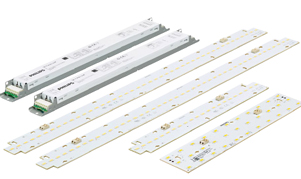
A linear LED light engine is a rigid circuit board populated with high-efficiency mid-power LEDs, designed as the light source for linear luminaires such as battens, troffers, panels, suspended linears and high bays. Combined with a matched constant-current LED driver, it forms a complete lighting system that replaces fluorescent tubes with a more efficient, longer-lasting and more consistent light source.

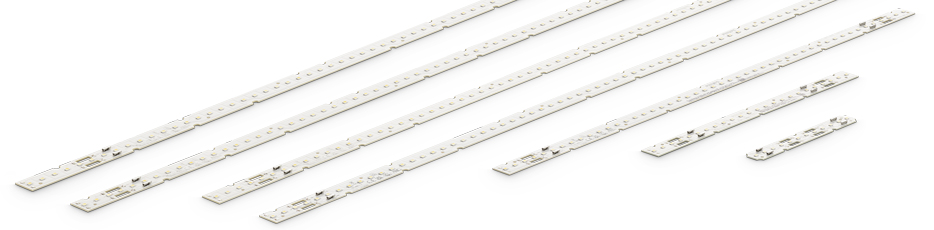
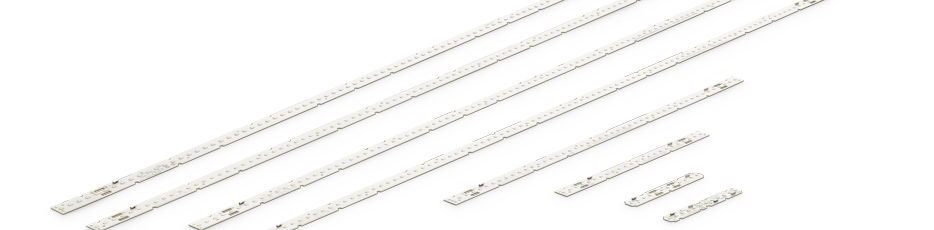
Our linear portfolio is based on Philips Fortimo modules from Signify. It includes Fortimo LED Line for general lighting, LED Line High Flux for high ceilings, slim Fortimo LED Strip in lengths from 0.25ft to 5ft, and ultra high efficiency UHE modules at up to 229 lm/W. Modules offer 3 SDCM colour consistency, CRI above 80 or 90, colour temperatures from 3000K to 5000K, and Zhaga-compliant form factors.

  • Efficacy up to 229 lm/W for lower energy use
  • Lifetimes above 50,000 and up to 100,000 hours
  • 3 SDCM colour consistency between luminaires
  • Zhaga-compliant form factors for easy design-in
  • Lengths from 0.25ft to 5ft to suit any luminaire size
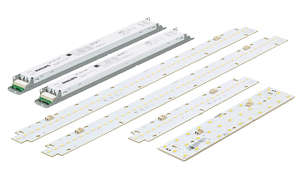
Linear range at a glance

  • Brand: Philips Fortimo (Signify)
  • Families: LED Line, LED Strip, UHE
  • Efficacy: up to 229 lm/W
  • Lengths: 0.25ft – 5ft
  • CCT: 3000K – 5000K
  • CRI: >80 and >90
  • Colour consistency: 3 SDCM
  • Lifetime: >50,000 – 100,000 hours
  • Standard: Zhaga compliant
Request a Quote Technical Enquiry

The technology

How a linear LED system works

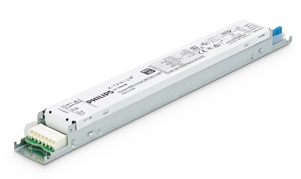
Linear light engines are driven by a constant-current LED driver, which holds the current through the LEDs at a set value. The light output of each module is set by that current, so the same module can be run harder for more lumens or softer for higher efficacy and longer life.

Each module has a forward voltage that scales with its length. Connected in series, module voltages add together, so several short modules can make one long run as long as the total sits within the driver's voltage window. Connected in parallel, the driver current is shared between modules.

The Zhaga standard defines the size, fixing points and electrical interface of compliant modules, so a luminaire can be designed once and use interchangeable light engines.

Constant-current driver powering linear LED modules connected in series, with forward voltages adding up Modules in series on a constant-current driver Constant- current driver Vf 1 Vf 2 Vf 3 Same current flows through every module Total voltage = Vf 1 + Vf 2 + Vf 3 (within driver window)
Simplified illustration: modules wired in series share one current, and their forward voltages add up to the total the driver must supply.

Product families

Choosing a linear light engine

Each Fortimo family is optimised for a different type of luminaire and mounting height.

FamilyEfficacyLifetimeCRI / CCTBest for
Fortimo LED LineUp to 165 lm/W>50,000 hours>80 and >90; 3000K – 5000KGeneral lighting with single, dual or triple LED rows
Fortimo LED Line High FluxUp to 158 lm/W>100,000 hours>80; 3000K – 5000KHigh ceilings, industrial and high-bay luminaires
Fortimo LED StripUp to 165 lm/W>50,000 hours>80 and >90; 3000K – 5000KSlim, high-performance linear luminaires
Fortimo LED Strip MF HV6178 – 187 lm/WSee datasheet>80Wide range of indoor linears, 0.25ft to 5ft lengths
Fortimo LED Strip UHEUp to 229 lm/WSee datasheet>80; 4000KMaximum efficiency to meet the latest regulations

Benefits

Advantages of linear LED light engines

Why luminaire makers build on proven linear LED modules.

High efficacy

Up to 229 lm/W on UHE modules cuts energy use and helps luminaires meet the latest efficiency regulations.

Long lifetime

Lifetimes above 50,000 hours, and up to 100,000 hours for High Flux, reduce maintenance compared with fluorescent tubes.

Consistent colour

3 SDCM binning keeps luminaires matched across an installation, with CRI above 80 or 90.

Flexible lengths

Modules from 0.25ft to 5ft combine in series or parallel to build almost any luminaire length and output.

Zhaga compliant

Standardised form factors simplify luminaire design and give a clear upgrade path to future module generations.

Proven system

Philips Fortimo modules from Signify, with system warranties of up to 5 years when used with approved drivers.

Design-in

Designing a linear luminaire

  • Set the target lumens and efficacy for the luminaire, then choose the module family and length to suit.
  • Choose the drive current: higher current gives more light, lower current gives higher efficacy and longer life.
  • Add up the forward voltages of modules in series and check the total sits within the driver's output window.
  • Select a matched constant-current driver, ideally programmable, with DALI or 1–10V dimming if required.
  • Manage heat by mounting modules on a metal surface and keeping within the rated operating temperature.
  • Choose optics or diffusers to control glare and give the light distribution the application needs.

Series voltage example

Using Fortimo LED Strip MF HV6 typical forward voltages:

  • 1 x 2ft module: 44.2V
  • 2 x 2ft modules in series: 88.4V
  • 1 x 4ft module: 88.4V

Two 2ft modules give the same voltage as one 4ft module, so the same driver can serve both luminaire designs. Always confirm against the module and driver datasheets.

Ask an Engineer
229 lm/W
Peak efficacy (UHE)
100,000h
Lifetime (High Flux)
3 SDCM
Colour consistency
0.25–5ft
Module lengths

Where linear light engines excel

Linear LED modules power most modern commercial and industrial luminaires.

Offices

Troffers, panels and suspended linears with high efficacy and consistent colour.

Industrial & warehouses

High-bay and batten luminaires using High Flux modules for tall spaces.

Retail

Trunking and linear systems with CRI above 90 for true product colours.

Education

Classroom and corridor luminaires with long life and low maintenance.

Healthcare

Ward, corridor and clinical luminaires needing high colour quality.

Fluorescent replacement

Retrofit and new-build luminaires replacing T5 and T8 tubes.

Our range

Explore linear light engines

Browse our linear modules and the drivers to power them.

FAQ

Linear light engine questions

A linear LED light engine is a rigid LED board designed as the light source for linear luminaires such as battens, troffers, panels and high bays. Used with a matched constant-current LED driver, it replaces fluorescent tubes with a more efficient, longer-lasting and more consistent light source.

Zhaga is an industry consortium that standardises the physical, thermal and electrical interfaces of LED light engines. A Zhaga-compliant linear module follows a standard form factor, so luminaires can be designed once and modules from compliant suppliers used interchangeably.

Linear modules are driven by a constant-current LED driver and are usually connected in series, in parallel or a combination. In series, the forward voltages add up, so the total must sit within the driver's output voltage window. In parallel, the driver current is shared between the modules.

Choose a constant-current driver whose output current matches the module's operating current and whose voltage window covers the total forward voltage of the connected modules. Programmable drivers let one driver type serve several luminaire sizes and light outputs. We can recommend a matched driver for your design.

SDCM measures how closely modules match in colour; 3 SDCM means differences are barely visible, so luminaires side by side look the same. CRI measures how naturally colours are shown; CRI above 80 suits offices and industry, while CRI above 90 suits retail, healthcare and hospitality.

Designing a linear luminaire?

Our team can help you choose the right Fortimo module, length and drive current, and match it with a suitable driver for your luminaire.

Talk to Our Engineers