Request a Quote

CV DMX Decoder Technology

How constant voltage DMX decoders turn a DMX512 signal and a DC supply into PWM dimming for LED strip, from 1 to 40 channels.

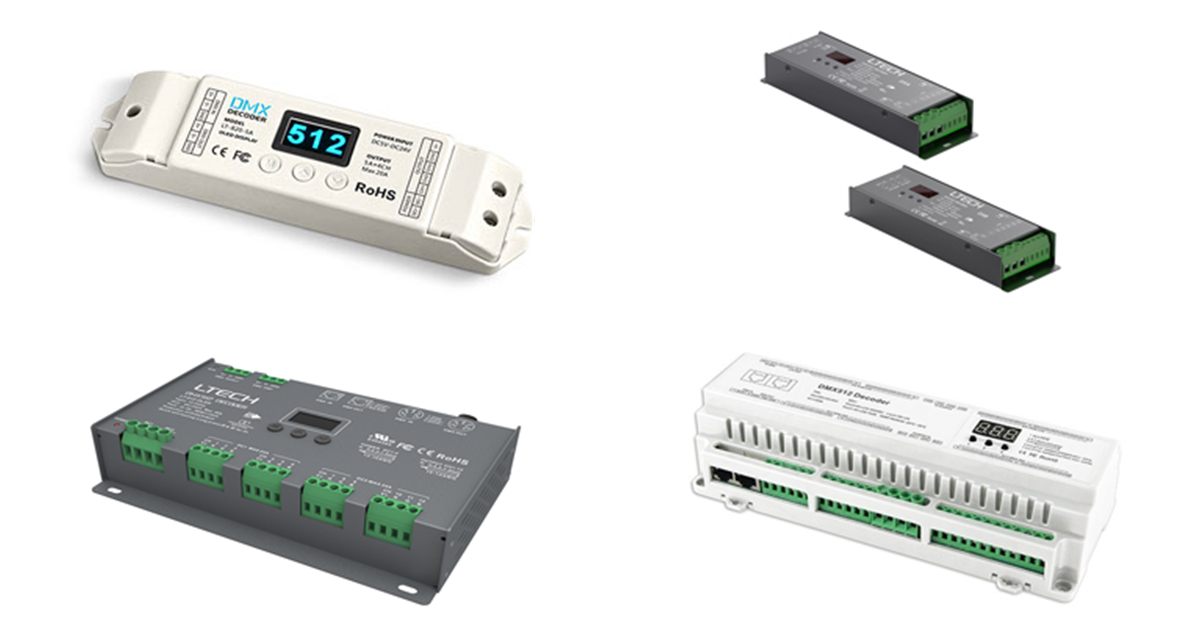
LT-820-5A, D5A, LT-912-OLED and BC640 DIN rail constant voltage DMX decoders

Overview

What are CV DMX decoders?

A constant voltage DMX decoder is the link between a DMX512 control system and 12V or 24V LED strip. It takes power from a separate DC supply and the DMX signal from the master, and dims each output channel to the level the master sends.

Our range runs from single-channel decoders for one run of strip to 40-channel DIN rail units for large installations, at 3A to 12A per channel. Most support RDM for remote addressing, and many have an OLED display, selectable dimming curves and 16-bit resolution for smooth low-level dimming.

  • DMX512 in, constant voltage PWM out
  • 1 to 40 channels, 3A to 12A per channel
  • 5–24V, 12–24V or 12–48V DC input
  • Address set on the display, by DIP switch or by RDM
  • Dimming, CCT, RGB, RGBW and RGB+CCT control
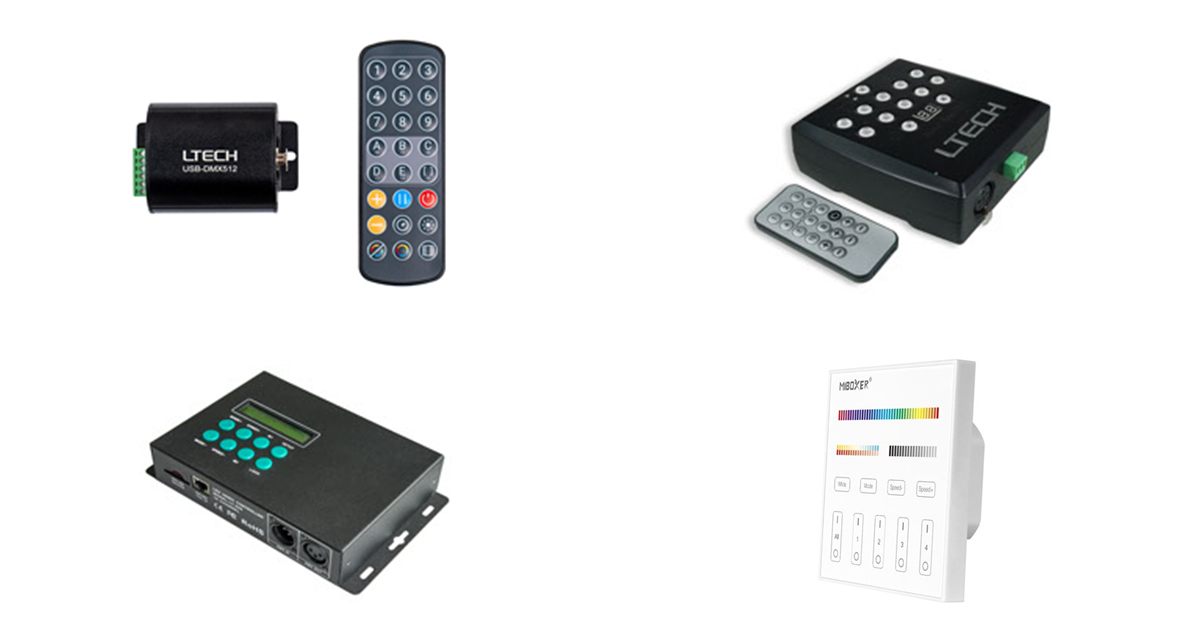
CV decoders at a glance

  • Input signal: DMX512, RDM
  • Output: Constant voltage PWM
  • Channels: 1 to 40
  • Current: 3A to 12A per channel
  • Supply: 5 to 48VDC
  • Dimming: 0–100%
  • DMX ports: XLR, RJ45, terminal
  • Mounting: Surface or DIN rail
Request a Quote Technical Enquiry

The technology

How a CV DMX decoder works

The decoder reads the DMX512 line and picks out the channels starting at its DMX address. Each DMX value from 0 to 255 sets the brightness of one output.

Each output is a MOSFET switch on the negative side of the strip. It switches the DC supply on and off thousands of times a second, and the share of time it is on, the PWM duty cycle, sets the brightness while the voltage stays constant.

The DMX signal also passes through the decoder to the next one on the line. Many decoders boost the signal as it passes, and the last one on the line takes a 120Ω terminator.

A DMX master and a 12 to 24V DC power supply both connect to a DMX decoder at address 001. The decoder drives four PWM channels to an RGBW LED strip and passes the DMX signal on to the next decoder. DMX and DC in, PWM out DMX master DMX512 in DC power supply 12–24V DC A001 DMX decoder CH 1–4 PWM out RGBW LED strip DMX to next decoder 120Ω at the last one
Simplified illustration: the decoder reads four DMX channels from address 001 and dims the strip's red, green, blue and white with PWM from the DC supply.

Channels

Matching channels to the LED strip

Each colour of each zone needs its own DMX channel and decoder output.

Strip typeDMX channels per zoneZones per universeExample decoder
Single colour1512LT-811-12A, 1 × 12A
Tunable white2256D4H in CT mode
RGB3170D4A / D4B, 3 × 8A
RGBW4128LT-820-5A, 4 × 5A
RGB+CCT5102D5A / D5B or LT-905, 5 × 5A

Multi-channel decoders such as the LT-932-OLED split their outputs into several zones, each with its own addresses.

Our range

CV DMX decoders compared

Ratings from each decoder's datasheet.

DecoderChannels × currentInputSet-up and DMX ports
LT-811-12A1 × 12A, plus 0-10V out12–24VDCOLED, RDM, 16-bit
LT-820-5A4 × 5A or 3 × 6A5–24VDCOLED, RDM, 16-bit
D4A / D4B4 × 6A or 3 × 8A12–48VDCDisplay, RDM, terminal (A) or RJ45 (B)
D5A / D5B5 × 5A, 4 × 6A or 3 × 8A12–48VDCDisplay, RDM, terminal (A) or RJ45 (B)
LT-D4L4 × 6A or 3 × 8A5–24VDCDIP switches, RDM, XLR-3, RJ45, terminal
D4H4 × 4A or 3 × 5A5–24VDCDIN rail, display, RDM
LT-9055 × 5A12–24VDCRDM, XLR-3, RJ45
LT-912-OLED12 × 4A12–24VDCOLED, RDM, XLR-5, RJ45, terminal
LT-916-OLED16 × 3A12–24VDCOLED, RDM, XLR-5, RJ45, terminal
LT-924-OLED24 × 3A12–24VDCOLED, RDM, XLR-3, XLR-5, RJ45, terminal
LT-932-OLED32 × 3A12–24VDCOLED, RDM, XLR-3, XLR-5, RJ45, terminal
BC640-DIN-DMX-4040 × 3A12–24VDCDIN rail, RJ45, terminal

Output power is the supply voltage times the total current: for example, the LT-932-OLED gives up to 2304W at 24V.

Benefits

Advantages of CV DMX decoders

Why a separate decoder and power supply suits DMX LED strip projects.

High channel counts

Up to 40 outputs in one unit for large multi-zone schemes.

Choose the supply

Use any suitable 12V, 24V or 48V DC supply, sized for the load.

Smooth dimming

16-bit resolution and selectable curves for flicker-free low levels.

RDM

Find decoders and change their addresses from the RDM master.

Easy set-up

Set the address and mode on the OLED or digital display.

Protected outputs

Short circuit, over-current and over-heat protection on most models.

Selection & set-up

Choosing and setting up a CV DMX decoder

  • Count the channels: 1 to 5 per zone, depending on the strip type.
  • Check the current: keep each channel's strip current within the decoder's rating, and the total within its maximum.
  • Match the voltage: the decoder's input range must cover the strip and power supply voltage.
  • Size the supply: allow the full strip load plus around 20% headroom.
  • Set the address: enter the start address on the display, DIP switches or from an RDM master.
  • Wire the line: daisy-chain the DMX to each decoder and terminate the last one with 120Ω.

Related technology and products

Complete the system with a master and power supplies:

Ask an Engineer
40
Max. channels
12A
Max. per channel
16-bit
Dimming resolution
48V
Max. DC input

Where CV DMX decoders are used

Wherever LED strip is controlled from a DMX system.

Architectural

Facade, cove and outline lighting in many zones.

Hospitality

Bar back, ceiling and feature strip lighting.

Entertainment

Stage, club and venue lighting from a DMX console.

Retail

Shelf, window and display strip lighting.

Exhibitions

Stand and showroom effects programmed per event.

Control panels

DIN rail decoders in central lighting control cabinets.

Explore

Explore DMX lighting control

Browse masters, drivers and controllers.

FAQ

CV DMX decoder questions

A constant voltage DMX decoder sits between a DC power supply and the LED strip. It reads the DMX512 signal from the master controller and switches the supply to each output channel with PWM, so each colour or zone of strip is dimmed to the level the master sends.

A DMX decoder has no power supply inside. It needs a separate 12V or 24V DC supply and only does the dimming. A DMX LED driver combines the mains power supply and the DMX dimming in one unit. Decoders suit high channel counts and existing DC supplies, while drivers save space and wiring.

Count one channel for each colour of each zone: 1 for single colour, 2 for tunable white, 3 for RGB, 4 for RGBW and 5 for RGB+CCT. Then check the strip current on each channel is within the decoder rating, from 3A to 12A per channel in our range, and that the total does not exceed the decoder's maximum.

RDM, Remote Device Management, adds two-way communication to the DMX line. With an RDM master, you can find each decoder, read its settings and change its DMX address without going to the decoder itself. Most of our CV decoders support DMX512 and RDM.

Most of our decoders have an OLED or digital display with buttons, where you enter the start address from 001 to 512. The LT-D4L and LT-830-8A use DIP switches, where the address is the sum of the switches turned on. RDM decoders can also be addressed from an RDM master.

Need help choosing a decoder?

Our team can help you size decoders, power supplies and LED strip for your DMX project.

Talk to Our Engineers